Biography
Jérémie Thircuir’s ceramic sculptures pay tribute to the legacy of European decorative arts while remaining firmly grounded in the present and the mundane. Working in Jingdezhen, the historic center of porcelain production in China, he uses jade porcelain, a rare material prized for its exceptional whiteness and purity. Fired in a gas kiln, it acquires a luminous surface that captures the finest details and lends each work an almost immaterial clarity.
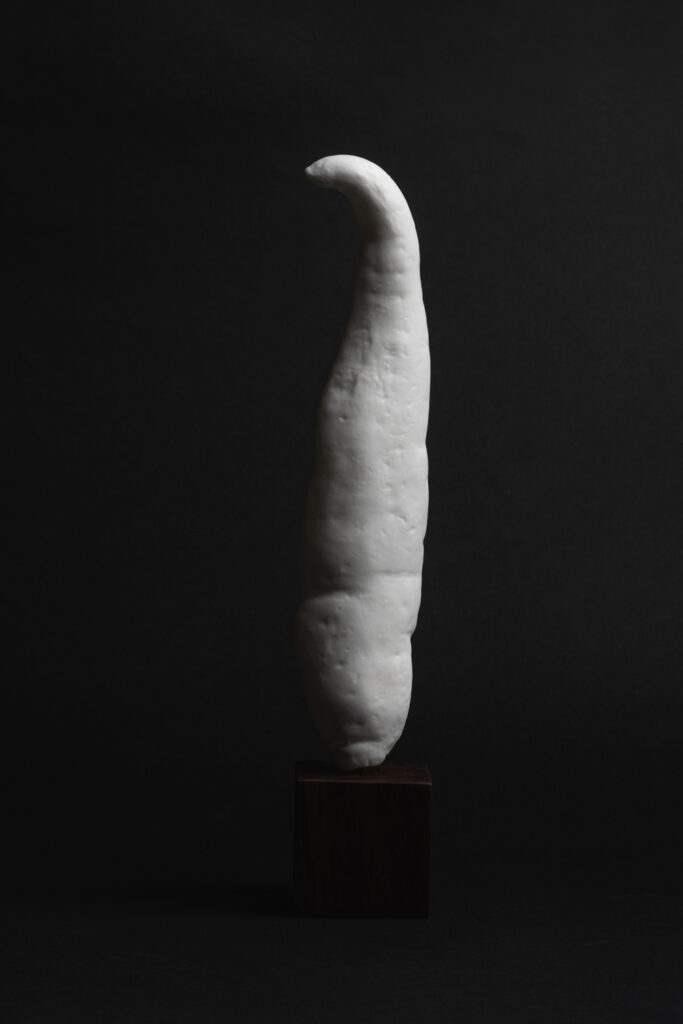
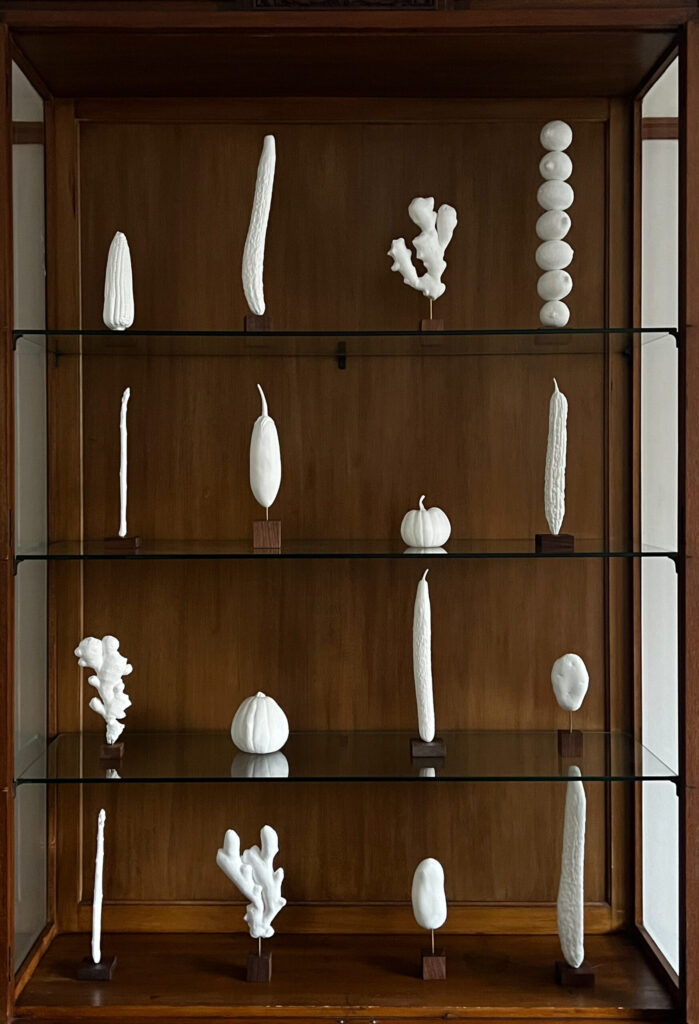
Each sculpture takes the form of a fruit or vegetable sourced from markets in Jiangxi province. By translating these humble organic forms into porcelain, Thircuir draws attention to what usually escapes notice. Fruits and vegetables are among the most familiar objects in daily life, yet their formal beauty often remains unseen. Through careful observation, precise modeling, and a restrained monochrome palette, he removes them from their immediate sensory associations—color, scent, taste—so that form, texture, and line come to the foreground.
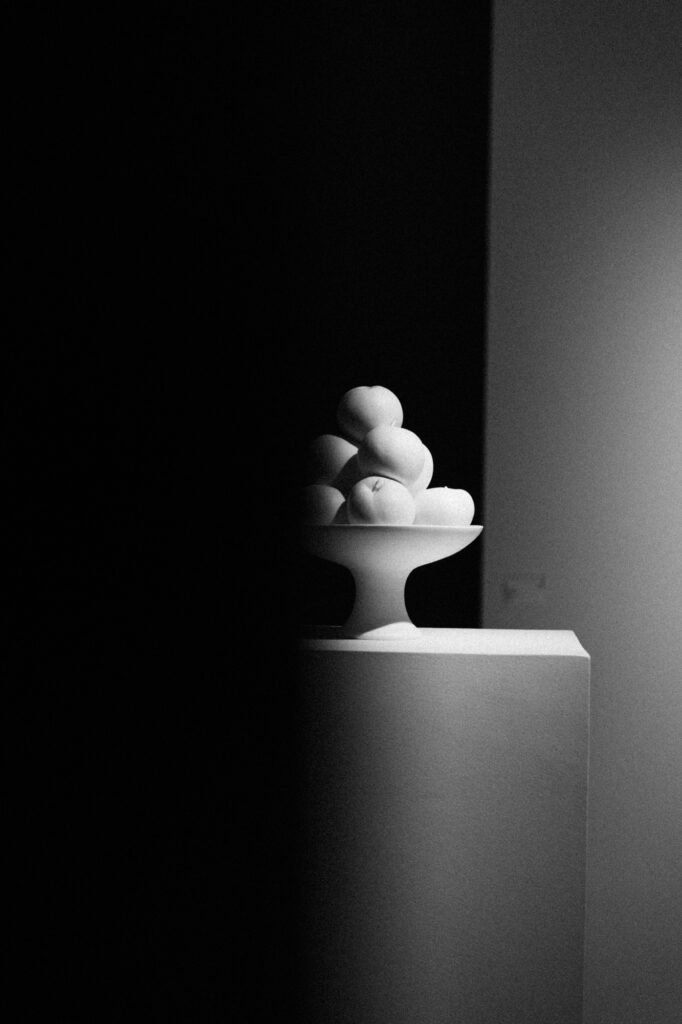
The whiteness of jade porcelain is central to this transformation. It heightens the sculptural presence of each object, inviting the eye to linger on curves, folds, surfaces, and rhythms shaped by millions of years of natural evolution. What is ordinarily handled, consumed, or overlooked is rendered still, contemplative, and quietly monumental.
In elevating the everyday to the realm of sculpture, Thircuir encourages a renewed attention to the natural world. His works remind us that beauty is not confined to the rare or the spectacular, but can also be found in the modest forms that surround and sustain us.
Exhibitions
2026
Feel The Void, Upsilon Gallery, Milan, Italy
Manifesto, XCommons, Kunshan, China
Xinkang Restaurant, Blunt Society, Shanghai, China
2025
Storytelling a la Française, Mouvements Modernes, Paris, France
Jérémie Thircuir & Lin Zhipeng a.k.a. 223, L’Etage, Arles, France
Units of Time, Cobra Gallery, Shanghai, China
Manifesto, XC273, Shanghai
Ephemeral Glow, Silent Shadows, Paintique, Shanghai (Curated by Song Tao)
2024
Xinkang Restaurant, Blunt Society, Shanghai, China (Curated by Ni Youyu)
Les Fruits du Destin, 1905 Art Space, Shenyang, China
Caring In…Caring Out, Hai550, Shanghai, China
The Ideal Home, Curated by Ling Licheng, Shanghai, China
2023
A Certain Idea About Complexity, A Certain Idea about Simplicity, N3 Gallery, Beijing, China
Cangjie Garden Art Festival, Cangjie, Suzhou, China
2020
As Time Goes By, Surging Wave Pavilion, Suzhou, China
Venit Occursum, Danysz Gallery, Shanghai, China
2019
Vegetable Stories, Camus, Shanghai, China
3cm Museum, K11 Art Foundation, Shenyang, China
The Shape of Nourishment
Ceramic Works by Jérémie Thircuir
In Jérémie Thircuir’s recent work, ordinary vegetables and fruits take on an unexpected presence. Ginger, bitter melon, eggplant, asparagus, citrus, root vegetables: all are recreated in fine white porcelain and presented with a kind of stillness that shifts the way they are seen. What at first might seem like a demonstration of technical precision gradually opens onto something quieter and more layered—a reflection on attention, material, and the strange power of familiar things.
Food has long occupied an important place in the history of images. Across different periods and cultures, fruits and vegetables have served not only as motifs drawn from daily life, but as carriers of meaning. In European still life painting, especially from the sixteenth and seventeenth centuries onward, humble ingredients were often charged with extraordinary intensity. A peach, a lemon, a bunch of grapes, a shellfish on a table: such objects could evoke abundance, mortality, sensual pleasure, or the passing of time. They were never only what they appeared to be.
Thircuir’s sculptures belong to this broader lineage, but they move in a different direction. Rather than building scenes or symbolic narratives, they isolate the object and allow it to stand on its own. There is no theatrical decay, no allegorical detail, no overt moralizing. What remains is the object itself—its silhouette, weight, texture, rhythm. In this respect, the work feels closer to traditions in which contemplation emerges through reduction: a single form, carefully observed, becomes sufficient.
That gesture is central to the strength of the work. These are not rare or luxurious ingredients. They are vegetables from the market, things pulled from the soil, handled, cooked, consumed, and often overlooked. Their forms are irregular, practical, even awkward. Yet through the processes of molding, casting, refining, and firing, they are transformed into porcelain—historically one of the most prized materials in Chinese art. The shift is not simply one of medium, but of attention. What is modest becomes monumental.
The fact that this work is rooted in Jingdezhen matters. The city carries centuries of technical knowledge and cultural weight as one of the historic centers of porcelain production. To work there is not only to access particular materials and skills, but to situate oneself within a long conversation about refinement, craft, and form. In Thircuir’s case, the use of an exceptionally white local porcelain body heightens this effect. Light does not bounce brightly off the surface; it settles into it. Details become softer, quieter, but also more exact.
The absence of glaze is important here. These sculptures do not rely on color or decorative embellishment. Their matte biscuit surface absorbs light and reinforces the sculptural character of each piece. A bitter melon becomes a sequence of ridges and cavities. A ginger root turns into a branching composition of tensions and protrusions. A corn cob reads almost architecturally. Removed from their natural colors, these foods are no longer descriptive in the ordinary sense. They become forms to be looked at anew.
This is where the work becomes especially compelling. Defamiliarization is often treated as a conceptual strategy, but here it remains tied to intimacy. These are objects everyone knows, yet very few people truly observe. They pass through the hand quickly. They are peeled, chopped, boiled, discarded. By translating them into porcelain and isolating them in space, Thircuir gives them back a kind of dignity. He asks the viewer to spend time with what is usually treated as incidental.
There is also a quiet humor in some of the forms, and with it a sense of warmth. Certain vegetables carry anthropomorphic or suggestive qualities that the artist does not suppress. But the work never collapses into gimmick or caricature. Instead, it remains grounded in the intelligence of the object itself. The sculptures do not insist on a meaning; they leave room for association, memory, and projection.
What emerges overall is not nostalgia, nor a romantic return to nature. These works are distinctly contemporary in their clarity and restraint. They are neither decorative quotations from tradition nor ironic commentaries on it. They sit somewhere else: between sculpture and document, between taxonomy and meditation. Each piece records a specific form found in the world, but also transforms it into something more enduring and more ambiguous.
Thircuir’s porcelain fruits and vegetables ultimately speak less about illusion than about perception. They slow the eye down. They ask what it means to really look at something commonplace. In doing so, they restore a sense of value to things that sustain daily life but rarely receive sustained attention. These are not monuments in a heroic sense. They are quieter than that. But perhaps for that reason, they linger. Their beauty lies not in spectacle, but in recognition.